
Why Three Unusual Deployments Made AI Live Chat PRO Stand Out in Customer Service, B2B Sales and WooCommerce
Why Three Unusual Deployments Made AI Live Chat PRO Stand Out in Customer Service, B2B Sales and WooCommerce
The first serious wave of WordPress AI chatbot plugins created a strange problem for businesses: almost every product could talk, but very few could reliably answer from the business itself.
That distinction matters. A visitor asking a tourism board about transport options, a business customer asking a bank about a commercial service, and a shopper trying to find a luxury watch are not asking for a generic AI conversation.
This video shows you why AI Live Chat PRO is a serious contender:
https://www.youtube.com/watch?v=BmqNMiMg9x0&t=4s
They are asking the organization to make its own information easier to use. Our quest for the best plugin started a few years ago and it took a twist:
This is exactly the context in which AI Live Chat PRO (developed by Adriaan Brits from Sitetrail) deserves closer evaluation. Across three real deployments — a European tourism board, a bank, and a luxury USA WooCommerce retailer — the software produced notably different but commercially meaningful results. The tourism board adopted it partly for GDPR reasons and reported that 95% of user feedback collected in the interface was positive. The bank used it in a B2B sales environment and reported a 40% reduction in sales headcount while increasing revenue. The luxury watch retailer used it to help shoppers navigate thousands of products, making paid traffic more effective by shortening the path from search click to relevant product.
Those are very different outcomes. The common thread is architecture.
AI Live Chat PRO is not simply another chat bubble attached to a large language model. It is a WordPress-native AI sales and support assistant that retrieves information from the organization’s own site before generating an answer. For companies comparing an AI chatbot for WordPress, a WordPress AI chatbot plugin, or a ChatGPT WordPress plugin, this distinction is now central. The question is no longer only “which model is connected?” The more important question is: “what does the model know, where did that knowledge come from, and can the answer be trusted?”
The Tourism Board: Customer Service Without Losing Control of Data
The tourism board deployment is useful because it was not primarily a sales case. It was a public-facing customer service case.
Tourism websites receive a high volume of repetitive questions. Visitors ask about transport, attractions, accessibility, opening hours, seasonal activities, public facilities, events, weather-dependent options, and local regulations. Much of this information already exists on the website, but visitors often cannot find it quickly. Traditional navigation assumes people know which page to open. Many do not.
A WordPress customer support chatbot can help only if it understands the organization’s own published content. A generic chatbot may produce polite answers, but politeness is not enough when the visitor needs official guidance. The tourism board needed an assistant that could answer from its own pages and policies, while still fitting European data governance expectations.
That is where AI Live Chat PRO’s WordPress-native structure became important. The plugin runs inside the customer’s WordPress environment and builds a managed knowledge base from the site’s content. For organizations evaluating a GDPR chatbot or a self hosted AI chatbot WordPress setup, that is a meaningful difference from hosted systems where knowledge, transcripts and user data may be routed through another SaaS platform.
The tourism board’s reported result — 95% positive user feedback inside the interface — should be read in that operational context. Visitors were not rating an AI novelty. They were rating whether they received useful answers quickly. In tourism, speed and confidence matter. A person planning a trip may not want to search through ten pages to find a transport rule or attraction detail. If the assistant gives a grounded answer from the official website, satisfaction rises because the site becomes easier to use.
That is the first lesson from the deployment: for customer service, AI is valuable when it reduces the distance between the visitor and the institution’s own verified information.
The Bank: B2B Sales Automation Without Treating Every Lead the Same
The banking deployment tested a different assumption.
In B2B sales, the problem is not merely answering questions. It is deciding which conversations require human attention and which can be handled through structured information delivery.
Banks receive many early-stage enquiries from businesses that are not yet ready for a sales meeting. Some prospects need basic explanations. Some need to understand eligibility. Others are comparing services. A human sales team can spend a large amount of time answering questions that are important but repetitive.
The bank used AI Live Chat PRO to absorb a substantial portion of those early interactions. The reported outcome was a 40% reduction in sales headcount while revenue increased.
This is the kind of claim that should not be reduced to “AI replaced people.” A more accurate interpretation is that the bank shifted human capacity toward higher-value conversations. A strong B2B sales assistant does not need to close every deal alone. It needs to clarify intent, answer from reliable material, keep the prospect engaged, and escalate when the conversation becomes specific enough to justify human involvement.
That is why a WordPress support chatbot used in B2B sales must behave differently from a simple live chat plugin WordPress site owners might install for basic messaging. The value is not the chat window. The value is the knowledge retrieval layer behind it.
AI Live Chat PRO’s architecture is designed around that retrieval layer. It can ingest WordPress pages, landing pages and business content into a knowledge base, retrieve relevant material on each turn, and generate an answer from that context. In a banking environment, this matters because the assistant must not improvise. It must answer from approved content, explain services clearly, and avoid misleading the prospect.
For companies evaluating an OpenAI chatbot WordPress setup or GPT chatbot WordPress implementation, the bank case highlights an important point: model access alone is not a business system. Connecting a site to OpenAI may produce fluent answers, but fluency does not automatically create sales efficiency. The commercial value comes from controlling the information the model uses, maintaining continuity across a conversation, and knowing when to hand over to a human.
The bank’s result suggests that, in high-volume B2B settings, the right AI chat system can materially change the economics of inbound sales. Not because it makes every salesperson unnecessary, but because it reduces the number of conversations that require a salesperson in the first place.
The Luxury Watch Store: WooCommerce Search Becomes a Conversation
The luxury watch store is perhaps the clearest ecommerce case.
Large WooCommerce stores often suffer from a paradox of choice. A catalogue with thousands of watches may be commercially strong, but it can become difficult for shoppers to navigate. Filters help, but only when the visitor already knows which filters matter. Many customers do not think in database fields. They think in intent.
A customer might want a gift for a collector, a dress watch under a certain budget, a steel sports watch with a blue dial, or a specific brand alternative. Traditional category pages force that customer to translate intent into filters. A WooCommerce AI chatbot changes the interaction by letting the shopper describe what they want in ordinary language.
This is where an AI chatbot for WooCommerce becomes more than a support tool. It becomes a guided discovery layer over the catalogue.
The watch retailer reported that customers found suitable watches faster in a busy category with thousands of products. That speed had a second-order effect: PPC traffic became more effective. When paid visitors arrived from Google Ads, the chatbot helped them move from a broad landing page to relevant products faster than navigation alone.
That matters because ecommerce advertising is not won only inside the ad account. A campaign can have acceptable CPC and still fail if the post-click experience is too slow. For luxury retail, this problem is amplified. The shopper may be interested, but if the catalogue feels overwhelming, the click is wasted.
A WooCommerce chatbot plugin that understands products, pricing and categories can therefore improve conversion economics without changing the ads themselves. It helps the visitor make sense of the inventory.
AI Live Chat PRO is built specifically for this type of environment. Its technical specification describes WooCommerce-aware knowledge ingestion, including product facts such as titles, prices and permalinks. It also supports mixed content, meaning structured products and unstructured landing pages can exist in the same knowledge base. That is important for stores where buying decisions are influenced not only by product data, but also by guides, brand pages, FAQs, warranty policies and campaign landing pages.
For a retailer comparing a WooCommerce chatbot, WooCommerce AI chatbot, or WooCommerce chatbot plugin, the key question is whether the system merely chats or whether it can accurately retrieve from the store’s own catalogue. In the watch case, the latter mattered.
Why Retrieval Beats Generic Chat
The phrase “AI chatbot” is now too broad to be useful.
A simple chatbot can answer general questions. A stronger WordPress AI chatbot can answer from the site. A serious WordPress chatbot plugin for commerce or B2B sales must do something harder: retrieve the right information from a changing business environment before the model responds.
AI Live Chat PRO’s design is built around hybrid retrieval. In plain English, that means it does not rely on only one method to find relevant content. It uses semantic retrieval to understand meaning and keyword retrieval to preserve exact matches where needed. It also searches across the knowledge base on every turn, rather than locking itself too tightly to one previously mentioned product or page.
That matters in real conversations.
A visitor might begin by asking about one service, then pivot to another. A shopper might ask about one product type, then change budget or style. A business prospect might start with a general question, then move into pricing or eligibility. If the chatbot gets stuck on the first topic, the conversation becomes frustrating.
This is one reason AI Live Chat PRO should not be evaluated as merely another live chat plugin WordPress users can add to a site. A traditional WordPress live chat plugin connects a visitor to a person or captures a message. AI Live Chat PRO attempts to answer before a human is needed, using the organization’s own knowledge as the source.
That is a different category.
The Model Is Not the Whole Product
Many buyers searching for a ChatGPT WordPress plugin assume that ChatGPT itself is the product. That is understandable but incomplete.
The model is only the language engine. The business outcome depends on what context the model receives.
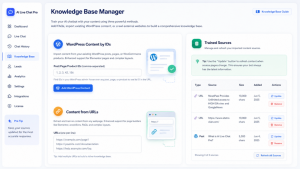
AI Live Chat PRO supports OpenAI and Grok, giving operators choice at the provider layer. But its differentiator is not simply that it can connect to a model. Its differentiator is the system around the model: content sync, retrieval, verified URL grounding, WooCommerce product facts, conversation continuity, and background indexing. Think about it: you click on a sync button, and it automatically connects to your ENTIRE Woocommerce store and landing pages, and indexes it without any manual work required – and then it adds the knowledge base for RAG vector creation, all with one click. That saves hundreds of hours.
This distinction is important because many failures in AI chat do not come from weak language models. They come from weak grounding. A powerful model can still hallucinate a link, misquote a price, misunderstand a product, or answer from outdated assumptions if the system does not supply current verified context.
For businesses comparing AI Engine alternative options, Tidio alternative options, or any AI chat plugin for WordPress, this is the practical evaluation standard: can the assistant answer from the business’s own material accurately enough to affect operations?
In the three deployments examined here, the answer appears to be yes.
The tourism board improved visitor satisfaction because users received official answers faster. The bank improved sales efficiency because repetitive early-stage conversations could be handled without immediate human involvement. The luxury watch retailer improved product discovery because shoppers could express intent conversationally instead of relying only on filters.
Each case reflects the same principle: AI works best when it makes existing business knowledge easier to access.
Human Handoff Still Matters
One reason enterprise buyers are cautious with AI chat is that not every conversation should be automated.
A good WordPress FAQ chatbot can answer common questions. A good WordPress support chatbot can reduce support volume. But businesses still need escalation. Complex complaints, sensitive issues, custom quotes and unusual cases require human judgment.
AI Live Chat PRO includes human handoff workflows, email notifications, session history, ratings, and integrations such as Mailchimp, HubSpot, Slack and webhooks. These features matter because they place the chatbot inside a broader operational workflow rather than treating the chat interface as a standalone novelty.
In the bank deployment, this distinction was especially important. The value was not total automation. It was better routing of human attention. In the tourism deployment, it allowed routine visitor questions to be answered quickly while preserving the option for human follow-up. In the WooCommerce case, it helped shoppers navigate inventory while leaving room for support or sales involvement when needed.
This is what mature AI implementation looks like. The assistant does not pretend every conversation is simple. It handles what can be answered from verified knowledge and routes the rest appropriately.
Why These Results Matter for the WordPress Market
WordPress remains one of the largest commercial web ecosystems in the world, but its AI tooling has been uneven. Many site owners have tried basic chat widgets, messenger plugins, support boards, helpdesk integrations, or generic chatbot scripts. Some work well for messaging. Fewer work well as grounded AI assistants.
That is why the market is shifting from “add chat to WordPress” toward more specific questions:
Can a chatbot understand WooCommerce products?
Can it answer from my landing pages?
Can it respect data governance requirements?
Can it reduce support workload?
Can it improve lead qualification?
Can it help paid traffic convert?
Can it work with OpenAI or Grok without making the business dependent on model memory?
AI Live Chat PRO is interesting because the three deployments answer these questions from different angles. Public-sector customer service, regulated B2B sales and luxury ecommerce do not usually share the same software success story. Here, they do because each needed the same underlying capability: reliable conversational access to the organization’s own information.
Final Evaluation
AI Live Chat PRO’s strongest claim is not that it is a chatbot. The market has enough chatbots.
Its stronger claim is that it turns WordPress and WooCommerce content into a usable conversational knowledge layer for customers, prospects and shoppers.
That is why the three deployments are notable. The tourism board showed that an AI customer service interface can satisfy visitors when it remains grounded in official information and supports GDPR-conscious operation. The bank showed that B2B sales teams can reduce repetitive workload and improve revenue efficiency when AI handles early-stage information delivery. The luxury watch retailer showed that WooCommerce stores with large catalogues can use conversational discovery to improve the value of PPC traffic.
Those results do not come from a chat bubble alone. They come from retrieval, grounding, catalogue awareness, provider flexibility and workflow design.
For organizations evaluating a WordPress AI chatbot, AI chatbot for WordPress, WooCommerce AI chatbot, or ChatGPT WordPress plugin, the lesson is straightforward: the winner is unlikely to be the tool that merely talks the best. It will be the tool that understands the business best.
More information about AI Live Chat PRO from Sitetrail is available at https://www.sitetrail.com/plugins/ai-live-chat-pro/.

Leave a Reply
Want to join the discussion?Feel free to contribute!